 Brochures
  Get in touch
  Join EFAP
 The History of EFAP: A Pioneer in Communication for 65 Years
The 1960s: A Foundational Decade for EFAP and Communication
In this series of articles, we offer you a journey through the history of EFAP over the decades, starting with the 1960s: a foundational period for both the school and the world of communication. Throughout these episodes, we will explore the major changes that shaped advertising, public relations, and the media, and how EFAP supported these transformations.
1961: The Birth of EFAP and a New Profession
EFAP (École Française des Attachés de Presse) was founded in 1961 by Denis Huisman, a visionary philosopher and educator. At that time, public relations were still poorly defined, and the role of the press attaché was not yet structured.
This profession was often seen as secondary and reserved for women, closely resembling the role of a hostess for journalists. However, Denis Huisman quickly recognized the strategic potential of these emerging professions.
To test public interest, he wrote a "Que sais-je?" on public relations and published an advertisement in *Elle* magazine offering courses. The result exceeded all expectations, with over 500 information requests quickly pouring in.
In response to this enthusiasm, he decided to open EFAP on rue Monsieur-le-Prince in the 6th arrondissement of Paris, in the heart of the Latin Quarter. The school was inaugurated in the presence of Christian Fouchet, the Minister Delegate for Information under General de Gaulle. In its first year, 150 students enrolled, proof of the growing interest in these new communication careers.
A School Connected to the Professional World from the Start
From its inception, EFAP stood out for its innovative teaching: the school maintained close ties with businesses and the media to train professionals who were immediately ready for the job. This connection with the field allowed the school to meet the needs of an industry in rapid transformation.
In 1967, EFAP took a significant step by moving to rue Pierre Charron in the 8th arrondissement of Paris. This move to a strategic district, close to major agencies and media outlets, supported the rapid development of the school.
The 1960s: A Revolution for Communication
The 1960s marked a major transformation in the media and advertising landscape. Fueled by the Trente Glorieuses, these years saw the rise of mass consumption and the emergence of new media.
Television gradually established itself as a mass medium, transforming the way brands communicated with the public. Advertising became a central element of popular culture.
Certain campaigns left a lasting impression, such as the 1967 campaign for Pipiou peas, with its famous slogan "You always need Pipiou peas at home." Broadcast on television, this advertisement left a lasting impact by associating canned peas with a reassuring, practical image in the everyday domestic life.
This choice of format and message aimed to position Pipiou peas not only as a food product but as a symbol of practicality, in line with the emerging consumer society of the 1960s. The advertisement highlighted the importance of this simple but essential product in French kitchens and its unavoidable presence in households, with a touch of modernity linked to the rise of television as a mass medium.
Thus, this campaign was part of a revolution in advertising at the time, where brands no longer just sold a product but created an image, an identity, and a lifestyle associated with the consumption of their products.
EFAP at the Heart of the Rise of Public Relations
In this rapidly changing context, EFAP quickly established itself as a major player in the training of communication professionals.
The school supported the emergence of modern public relations through a teaching approach focused on practice and industry professionals.
As early as 1964, EFAP participated in its first major national campaign, conducted with Europe 1 and the magazine Elle, to equip a laboratory at the Villejuif Cancer Institute.
That same year, Marcel Bleustein-Blanchet, founder of Publicis, became the sponsor of a graduating class. This symbolic support marked EFAP's growing recognition by key players in the communication industry.
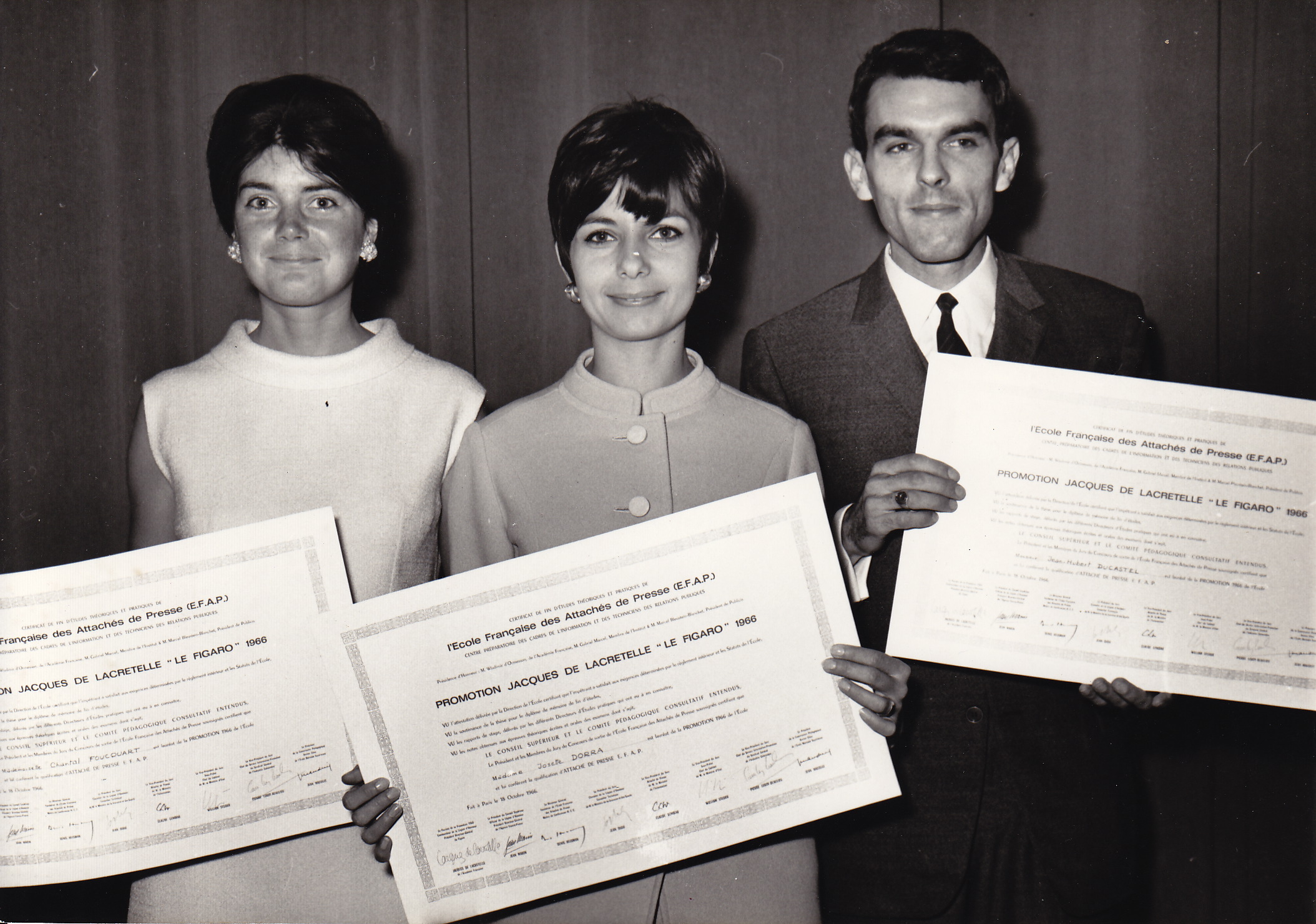
Graduation ceremony of the EFAP 1966 class
📅 The 1960s in Key Dates
Several key events illustrate both the evolution of EFAP and the transformations in communication during the 1960s:
1964: First major national campaign led with Europe 1 and *Elle* magazine.
1965: Launch of *L’Express* and *Le Nouvel Observateur*, which transformed the French media landscape.
1967: Airing of the iconic TV commercial for "You always need Pipiou peas at home."
1968: Authorization of the first commercial advertisements on French television.
1969: First steps of Neil Armstrong on the Moon and the creation of Arpanet, the precursor to the internet.
These events reflect a decade marked by technological, media, and cultural acceleration, which profoundly transformed the communication professions.
A School Evolving with Communication Professions
Since its founding in 1961, EFAP has continuously evolved to keep pace with changes in the industry: advertising, public relations, media, digital communication, and influencer marketing. Today, the school trains students each year for careers in communication through a professional-oriented pedagogy, combining academic teaching, hands-on projects, and internships.
Discover EFAP's Programs
Want to work in communication, marketing, or the media?
For over 65 years, EFAP has been training tomorrow's communication professionals with a pedagogy focused on business and industry realities.
👉 Discover EFAP's programs and shape your future in communication.
See other news
Back to school 2026 - Admission outside Parcoursup at EFAP!
The time has come to design your orientation project and choose the path that suits you. While end-of-year procedures often focus around the official platform, there is an alternative outside of Parcoursup to turn your communication ambitions into reality right now. And it's happening at EFAP!
read more

Master en Communication Internationale : Pourquoi choisir l’EFAP ?
Dans un monde de plus en plus connecté, la communication dépasse les frontières. Les entreprises et organisations recherchent des professionnels capables de travailler sur des projets internationaux, de collaborer avec des équipes multiculturelles et de s’adapter à des contextes variés. Intégrer la formation en communication internationale de l’EFAP, c’est bénéficier d’un programme complet et tourné vers l’international. Avec plus de 30 000 diplômés depuis 1961, l’école forme des professionnels polyvalents et experts, prêts à relever les défis du marché global.
read more

Quels sont les métiers accessibles après une formation marketing digital à Paris ?
Le domaine de la communication regroupe une grande variété de métiers, à la fois techniques et créatifs. La formation en marketing digital à Paris proposée par l’EFAP constitue un véritable tremplin pour y accéder, grâce à la qualité de son enseignement, à son vaste réseau d’entreprises et à la diversité des secteurs porteurs de la capitale (luxe, agences, médias…). Découvrez comment cette école de communication permet de se démarquer dans un environnement compétitif et en constante évolution.
read more