 Brochures
  Get in touch
  Join EFAP
Our Bachelor's Degrees in Communication
School Degrees (3 years of higher education - 180 ECTS)
 90%*
90%*
of our graduates find a job within 6 months of graduating from the school
*RNCP title, "Marketing and Digital Transformation Manager ». Top 1
Top 1
EFAP Program - EFAP School of Communication
Eduniversal Ranking 2026
The Bachelor's degree programs in Communication offered at EFAP: training in communication and marketing
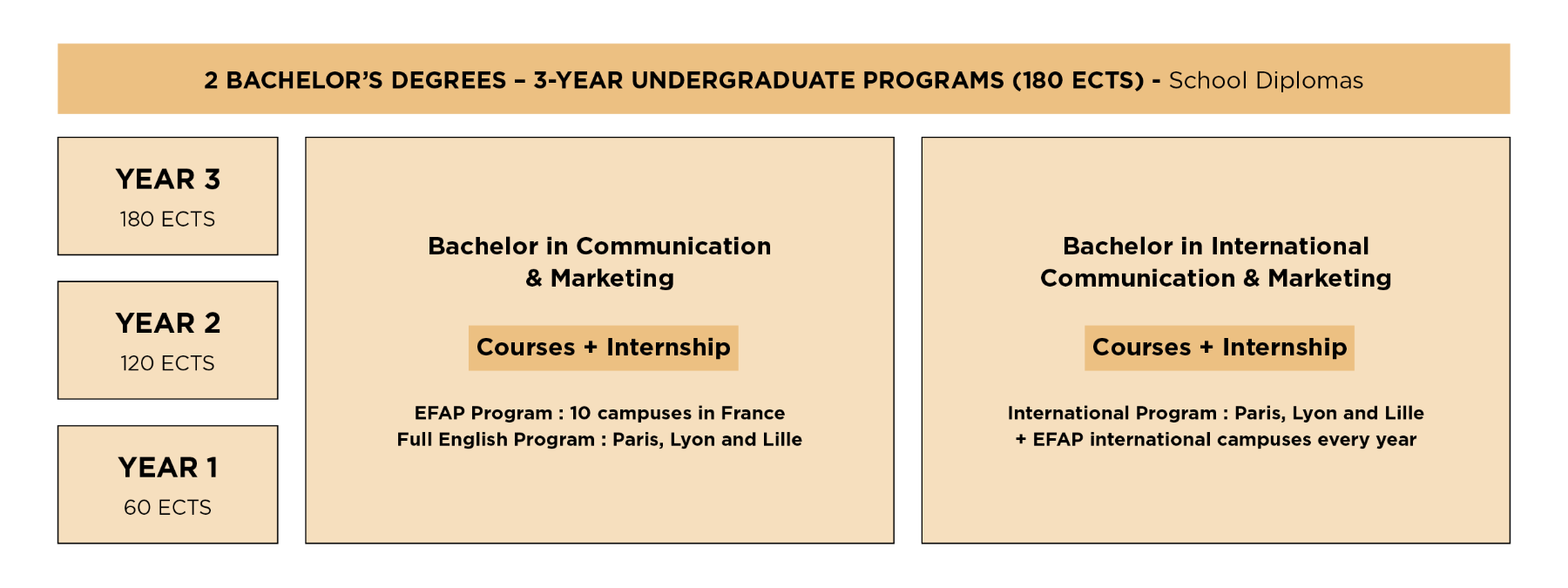
EFAP communication school offers two three-year Bachelor’s programs (180 ECTS), leading to school-issued diplomas and designed to provide students with a solid foundation in communication and marketing before specializing through an Specialized MBA program.
Each bachelor's degree program lasts 3 years, offering students a comprehensive, career-oriented education that prepares them for careers in a variety of fields within the communications industry.
Objectives:
EFAP's Bachelor's degrees in Communication enable students to master the fundamentals of communication and marketing, equipping them with the essential skills to succeed in these fields. In particular, students will learn to:
- Understanding businesses' communication and marketing needs.
- Use key communication and marketing techniques.
- Create and manage campaigns tailored to different audiences.
- Manage the brand image and customer relationships.
Bachelor's Degree in Communication & Marketing (in French or entirely in English)
Course in French:
This program is available at 10 campuses across France, offering a career-focused curriculum that prepares students for careers in communications and marketing. Students benefit from internships and personalized support to help them build their professional network.
Available campuses: Aix-en-Provence, Bordeaux, Lille, Lyon, Montpellier, Nice, Paris, Rennes, Strasbourg, Toulouse.
Course in English:
Available at the Paris campus, this program is taught entirely in English and prepares students for the same careers in communication and marketing. It places a strong emphasis on practical experience through company internships and dedicated support to help students build an international professional network.
Campuses available: Paris.
International Bachelor’s degree in Communications & Marketing (full english)
This unique program offers a mandatory international exchange every year at EFAP International campuses, with courses taught entirely in English starting in the first year. In addition to the exchange, this track allows students to choose from 8 dual degree programs with partner universities around the world.
Campuses available: Paris.
Progression rate from Year 3 to Year 4: 99%
Next step: EFAP 4th year
You may be wondering about taking one of our training courses. Contact us, so that we can provide you with the information and guidance you need: accessibilite@efap.com.
The Bachelor's Program in Communication
Bachelor's in Communication, 1st Year - Mastering the Fundamentals of Communication
Core courses and introduction to communication careers (60 ECTS)
Whatever program they choose, our students benefit from the same high-quality communication training, and skills are developed at the same pace. The language of instruction (French or English), as well as internship periods or international study experiences (on EFAP campuses or at partner universities), do not impact the quality of teaching or the acquisition of technical skills.
Next school year: September 2027
Mid-year intake: It’s possible to change direction during the year! Thanks to an adapted teaching approach and an accelerated program, you can reorient without losing a year. By joining the mid-year intake at EFAP Communication School, you can validate your first year in just 6 months, with the same courses as students who enrolled in September.
Duration of the program: approximately 450 hours
Objectives
Discover the fundamentals of communication in all its dimensions through courses focused on current issues and innovative teaching methods that encourage each student to push beyond their limits and give their very best.
Explore the professional world, thanks to a first internship and meetings with communication industry professionals.
Methods and assessment procedures
- Theoretical courses, practical workshops, challenges and professional projects
- Continuous assessment and mid-term exams
Practical and theoretical training & soft skills
Communication & Marketing
› Communication Theories
› Fundamentals of Event Management
› Fundamentals of Marketing
› Introduction to Social Media
› Writing Techniques
› Marketing and Market Research
› Communication Plan
› Media Relations
Creativity
› Video Editing
› Creative Concept Development
› Podcast Production
› Introduction to Graphic Design
General Knowledge
› Current Affairs: Analysis and Insights
› Advertising Culture
› History and Overview of the Media
› Geopolitical Current Affairs
› Culture and Myths in Communication
› Consumer Psychosociology
› Business English for Communication
Professional Methods & Tools
› Interpersonal Communication
› Methodology Workshop
› Fundamentals of Organizations
› Prompt Engineering
Educational events
Masterclasses
Challenges & Seminars
› ComExplorer
› Creative Experience
› Creative Battle
› Culture Lab Day
Workshops and professional projects
› Personal Branding
› Professional Development Workshops
Two-month discovery internship
First year highlight: The Creative experience
A highlight of the first year, organized a few weeks after the start of the academic year, the Creative Experience invites students to set up their own communications consultancy and manage their "creative team" from idea to baseline, including moodboard, photo, storyboard, etc.
Bachelor's in Communication, 2nd Year - Acquiring Key Tools and Skills
Core courses and development of operational skills (120 ECTS)
The second year of the Communication program combines fundamental courses in marketing and communication with the acquisition of essential skills required to work in various communication careers.
Next school year: September 2027
Duration of the program: approximately 450 hours
Objectives
- Acquire fundamental knowledge in marketing and communication.
- Develop the professional skills essential to working in the various communication-related professions.
- Offer students the opportunity to experience their first international experience as early as the second year, either on an overseas campus or at a partner university, through the Full English Program or the International Program.
Methods and assessment procedures
- Theoretical courses, practical workshops, challenges and professional projects
- Continuous assessment and mid-term exams
Practical and theoretical training & soft skills
Communication
› Non-Profit Communication
› Cross-Cultural Communication
› Communication and Media Law
› Event Production
› Communication Strategy
Creativity
› Pop Culture and the Arts
› Graphic Design and Visual Identity
› Image and Photography in Communication
› Copywriting
› Graphic Design & AI
› Journalistic Writing
› Mini-Series
Marketing, Digital & Business
› Project Management
› Strategic Marketing
› Digital Marketing
› Budget Management
› Social Media Strategy
› Introduction to Data
Media Management
› Media Planning & AI
› Media Seminar
› Media Relations Strategy
Educational events
Masterclasses
Challenges & Seminars
› Influencer Marketing Seminar
› Battle
International Lab Day
Workshops and professional projects
› Professional Development Workshops
› Meetings with Industry Professionals
Three-month internship
Second year highlight: Data Lab Day
Today, data is at the heart of all communication strategies. Understanding, analyzing and exploiting data has become essential for anticipating trends, personalizing messages, measuring the impact of campaigns and steering performance. The Data Lab Day offers students a chance to explore these themes.
Bachelor's in Communication, 3rd Year - Developing Your Career Plan
Mastering techniques and building your professional project (180 ECTS)
Structured around major practical projects, the third year of the Communication program aims to develop and refine increasingly advanced communication techniques and present them in the form of professional recommendations. This third year places strong emphasis on digital communication, crisis communication, and the strategic challenges of CSR communication.
Next school year: September 2027
Duration of the program: approximately 450 hours
Objectives
- Acquire fundamental knowledge in marketing and communication.
- Develop the professional skills essential to working in the various communication-related professions.
- Offer students the opportunity to experience their first international experience as early as the second year, either on an overseas campus or at a partner university, through the Full English Program or the International Program.
Methods and assessment procedures
- Theoretical courses, practical workshops, challenges and professional projects
- Continuous assessment and mid-term exams
Practical and theoretical training & soft skills
Digital Initiatives
› Content Management Systems
› AI Design
› Digital Sprint
› GEO SEO Strategy
› UX Design
360° Communication
› Corporate Communication
› Crisis Communication
› Public and Political Communication
› CSR Communication
Marketing & Data
› Project Budgeting
› Introduction to Data
› Operational Marketing & CRM
› Data Protection and Intellectual Property
Marketing & Strategy
› Storytelling and Narrative Communication
› Creative Strategy
› Media Training
Educational events
Masterclasses
Challenges & Seminars
› Sprint Days
› Talk Show Factory
› Brief Your Agency
Workshops and professional projects
Meetings with Industry Professionals
6-Month Internship or Semester Abroad
Third year highlight: The Big Battle
A two-week national competition bringing together nearly 900 EFAP students around a problem proposed by a well-known brand. The aim: to deliver the best strategic recommendation! On the program: coaches, training sessions, challenges... and the grand finale at the advertiser's premises! An unforgettable moment in your EFAP training. #BigBattleEFAP
FAQ
What do I learn in my first year at EFAP?
The first year at EFAP is an introductory year to the fundamentals of communication and marketing. Students discover the basics of global communication, digital tools, event management, press relations and oral and written expression. It's also a year of methodology and refresher courses, helping to develop cross-disciplinary skills (creativity, critical thinking, general culture, teamwork). Right from the first year, students take part in battles and concrete projects supervised by professionals, to get to grips with the realities of the profession.
What are the basic courses taken in the first year at the EFAP School of Communication?
In the first year, courses cover the essentials of the communication and marketing professions. Students also follow personal and professional development modules (project methodology, writing, public speaking, collaborative work). These theoretical and practical courses are designed to give students a global vision of the sector and prepare them for their first professional experiences through internships.
Is an internship compulsory in the first year at EFAP?
Yes, as early as the first year at EFAP, students complete a compulsory internship to get a hands-on feel for the professional world. This first internship, lasting two months, enables students to put their theoretical knowledge into practice and gain a better understanding of the different communications professions (agencies, associations, media, companies). It's a first professional immersion that helps confirm your career choices and enrich your CV right from the start of the course.
Find out more about internships at EFAPWhat types of practical projects are carried out in the first year at EFAP?
From the first year onwards, EFAP students take part in numerous practical projects that complement the theoretical courses. They take part in Masterclasses led by experts, creative challenges like the Creative Experience, the Creative Battle or 100 % Advertising Challenge, which plunge them into situations close to professional reality.
Every year, students also take part in Lab Days, themed days of innovation and collective reflection. These include the AI Lab Day dedicated to artificial intelligence, the CSR Lab Day focusing on societal and environmental issues, and the Culture Lab Day exploring cultural and creative trends.
What do I learn in my second year at EFAP?
The second year at EFAP is one of deepening: students consolidate the fundamentals seen in first year and develop more operational skills. They work on strategic communications, digital marketing, project management and multimedia content creation.
What core courses are offered in the second year at EFAP?
In the second year at EFAP, students delve deeper into the basics of communications through a wide range of theoretical and practical courses.
The program covers :
- Communication & media: communication strategy, media relations strategy, media planning, journalistic writing, semiology, communication and media law.
- Creativity: copywriting, pop culture and art, graphic design, image and photography in communication, web series.
- Marketing, digital & AI: strategic and digital marketing, marketing tools, digital transformation, AI & data, ethical and societal issues linked to AI
- Strategies & projects: nonprofit communication, project management, budgeting, methodology and professional tools.
These courses are complemented by professionalization workshops (public speaking, public presentation), and help prepare for the mandatory three-month internship.
Is there a compulsory internship in the second year at EFAP?
Yes, the second year includes a compulsory three-month internship. This internship enables students to gain responsibility and put into practice the skills acquired during the year. It can be carried out in France or abroad, in a variety of sectors (communications agencies, media, start-ups, institutions, associations). It's a key step in gradually building your career path.
Find out more about internships at EFAPWhat types of practical projects are carried out in the second year at EFAP?
In the second year, students take part in Masterclasses led by professionals, as well as challenges and seminars such as the Influence Seminar. They also take part in Lab Days, such as Data Lab Day (focusing on data-related issues) and International Lab Day, which promotes multicultural openness. These projects complement the courses and provide a real-world setting for current communication and digital issues.
What do I learn in my third year at EFAP?
The third year at EFAP marks a reinforced professionalization stage. Students deepen their mastery of communication through specialized courses in crisis communications, public and political communication, CSR, internal communication and employer branding. The year also develops the creative and digital dimension, with courses in storytelling, motion design, UX design and SEO with AI. It's a pivotal year that prepares you for more strategic assignments.
What are the core courses in Third year at the EFAP School of Communication?
The academic program covers several major areas:
- Communication: crisis communications, public and political communication, CSR, internal communication.
- Creativity: creative strategy, storytelling & narrative communication, motion design.
- Digital & AI: CMS, SEO & content strategy with AI, UX design, web design.
- Marketing & business: operational marketing, digital marketing projects, budget management, data protection and intellectual property.
These courses offer a comprehensive approach, combining strategy, creativity and mastery of digital tools.
Is there a compulsory internship in the third year?
Yes, the third year includes a mandatory 6-month internship. Students can also choose to spend a semester studying abroad at one of EFAP’s partner universities. This experience is key to broadening their professional horizons, developing intercultural skills, and building a distinctive CV. Whether through an internship or an academic exchange, the third year provides students with their first extended immersion in a professional and/or international environment.
Find out more about internships at EFAPWhat types of practical projects are carried out in the third year at EFAP?
Alongside their courses, students take part in a number of educational events: Masterclasses led by experts, Big Battle (a life-size challenge based on a real brief), 100% Crisis Comms (an intensive seminar) and the CSR Lab Day focusing on responsible communication. These hands-on projects enable participants to confront current issues and develop concrete skills in crisis management, brand strategy and sustainable communications.
What is the employment rate after EFAP?
90%* of our graduates find a job within 6 months of graduating from EFAP. This high employment rate is a testament to the strength of our professional network and the practical preparation of our students for the realities of the job market.
*RNCP title, "Marketing and Digital Transformation Manager ».
What is the difference between a communications school and a business school?
A communication school and a business school differ primarily in their focus and curriculum. Communication schools focus on careers in communication, marketing, public relations, and media. They prepare students for careers in fields such as advertising, event management, digital communication, and media relations. The programs focus on content creation, brand image management, and internal and external communication strategies.
In contrast, a business school offers a more broad-based education in management, finance, strategic marketing, and leadership. It prepares students for roles in business management, leadership, and business strategy across various sectors such as finance, management, and international trade.
If you want to work in creative and strategic fields related to communication, a school specializing in communication, such as EFAP, will provide you with the tools you need to excel. On the other hand, if you’re aiming for a career path more management-oriented and focused on the financial aspects of business, a business school would be a better fit.
Communication schools place a special emphasis on creative and strategic skills, offering specialized programs that directly address the needs of the market and communication firms.
Also discover the program