 Brochures
  Get in touch
  Join EFAP
 Rencontre avec Marguerite Lengereau, Planneuse Stratégique chez Ogilvy
Marguerite Lengereau, after more than four years as a strategic planner at Ogilvy Paris, shared her expertise on this hard-to-define profession.
With a strong curiosity for the world around her, Marguerite helps brands adapt to their environment by placing culture at the heart of their strategy. Discover her thoughts on the role of culture in communication, the evolution of creativity in agencies, and the impact of artificial intelligence.
Q: Could you introduce yourself briefly and tell us about your role at Ogilvy? And what exactly does the role of a strategic planner entail in a large agency?
Marguerite Lengereau:I’ve been working as a strategic planner at Ogilvy for five years. My main role is to ensure that communication campaigns are both relevant for consumers and effective for brands.
In reality, my goal is to analyze the world around us. This job requires a great deal of curiosity: observing behaviors, tracking the evolutions of society, brands, and sectors in order to identify tensions, then use these elements to tell a relevant story for the brand. Because beyond selling, advertising needs to take people into a brand universe that accompanies them and pushes them to discover new things.
Q: Why is it important to integrate culture into brand strategy?
Marguerite Lengereau: Integrating culture into brand strategy is essential because it ensures the relevance of content. As consumers, it’s our emotions and references that filter the information we receive and determine what interests us.
What I would like to pass on to future communicators is the importance of nourishing yourself with everything. You have to be curious, because the foundation of a strategic planner's job is first and foremost openness to the world. Nourishing yourself isn’t just about watching the news, reading newspapers, or following social media. It also includes nurturing personal passions, DIY, books…
This ability to observe and understand the world is essential. To be a good communicator, curiosity is probably the best weapon we can have.
Q: This afternoon, you're guiding students through cultural references in pop culture. What, in your opinion, are the reality pitfalls when a brand uses a meme or cultural reference?
Marguerite Lengereau: When a brand wants to use a meme or cultural reference, the biggest risk is simply copying a trend or movement just to look "cool" or "pop culture." That won’t work: for a brand, simply replicating a meme or a trend without understanding its true context can create a dissonance.
The second trap is not thinking about the identity of the brand. Every brand has its values, and not all cultural elements are relevant for every brand. What works for a clothing brand, for example, won’t work for a gaming brand. It’s crucial to understand which cultural territories align with the brand’s story and values, while avoiding those that don’t resonate with the target.
Finally, the third pitfall is failing to anchor culture in the reality of society. Communication must always start with a tension, a problem the brand is solving. Integrating culture is important, but it must always be done within the context of a concrete goal, not just to "be cultural." Culture must be used to show that the brand understands societal issues and addresses them in a relevant way.
Q: How do you see creativity evolving in agencies, especially with the rise of artificial intelligence? Is it shaking up the thought process?
Marguerite Lengereau: The arrival of artificial intelligence is certainly shaking things up, and that’s no secret. In my role as a strategic planner, a big part of my job involves doing research and absorbing new information. AI helps me go three times faster, which is a huge advantage. However, its main danger lies in the fact that it should never replace our critical thinking.
Artificial intelligence is truly useful when it’s well used. It serves to stimulate our critical thinking, pushing us to ask the right questions. For example, it can quickly synthesize a market or subject with key information. That’s an incredible time-saver. But we mustn’t stop at this step; it’s important to go further and use AI to refine our thinking.
As for its impact on creativity, the answer is both yes and no. If we look at certain campaigns, like the Intermarché at Christmas, we see just how irreplaceable human creativity is. An AI works based on algorithms and probabilities. It calculates the most likely correct response, but it doesn’t capture the essence of human creativity.
Human creativity is emotional. It’s based on intuitions and instincts that are sometimes difficult to define. It’s also the ability to draw inspiration from small observations of everyday life, like a creative person noticing particular behavior in people. For me, AI can’t replicate that yet.
It’s essential to keep in mind that AI can evolve our professions, but we must absolutely preserve our human creativity, as it is our true strength.
Through her reflections and advice, Marguerite Lengereau invites us to rethink communication, nurture our curiosity, and integrate culture into brand strategies. She emphasizes the importance of human input in creativity and the necessity of combining technology with critical thinking in the communication professions.
Want to experience more inspiring encounters with communication professionals?
At EFAP, we offer you the opportunity to meet passionate experts, exchange ideas on current challenges, and enrich your career path. Join us for a unique experience and get ready to tackle the challenges of the communication world. Discover our programs
See other news

Quels métiers sont accessibles après une formation événementiel Rennes à l'EFAP ?
Près de 20% des diplômés de l’EFAP évoluent dans l’événementiel, un chiffre qui souligne l’importance de ce secteur au sein de l’école. Installée dans une ville dynamique et attractive, la formation en événementiel à Rennes permet aux étudiants de bénéficier d’un environnement stimulant, d’un tissu économique local riche et de nombreuses opportunités professionnelles.
read more
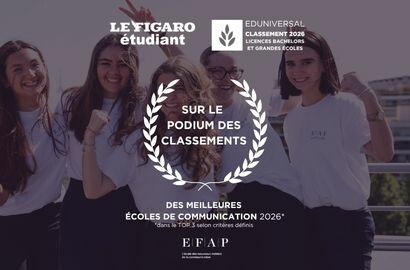
EFAP: on the podium of the 2026 rankings of the best communication schools
EFAP continues to position itself among the best communication schools in France and internationally. With prestigious rankings that recognize the quality of its programs, the school reaffirms its status as a leader in training future communication professionals. Known for its academic excellence, international outlook, and high employability rate, EFAP prepares its students to face the challenges of an ever-evolving sector, offering them a curriculum tailored to the needs of businesses and contemporary issues.
read more
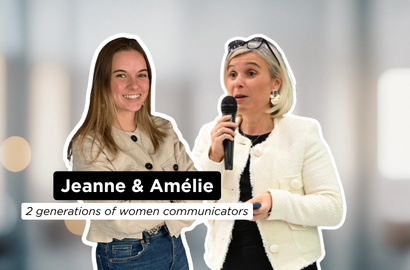
EFAP Generations: communication, a family story from Lille to Toulouse
What do the late 90s, marked by the early dawn of digital, and the year 2026, driven by artificial intelligence and social media content creation, have in common? One school, one passion, and above all… a family bond!
read more