 Brochures
  Get in touch
  Join EFAP
 Project-based learning, public speaking and impact: why public speaking is central at EFAP
In a school of communication, professional success depends as much on mastering strategies as on the ability to speak in public, listen and interact with others. At EFAP, where project-based learning lies at the heart of the teaching approach, public speaking and interpersonal communication are essential skills for defending ideas, convincing an audience and collaborating effectively.
We had the opportunity to speak with Frédérique Maupu-Flament, journalist, fiction writer and lecturer at EFAP, who shared his approach to public speaking and explained why training students in these areas is now essential.
🎙️ Why learning public speaking in a school of communication is essential for professional success
In a school of communication, public speaking plays a central role in training future professionals. Being able to speak in public, structure a message and persuade an audience are now essential skills in communication careers.
Project presentations, media appearances, strategic meetings or client pitches: mastering oral expression is a powerful driver of credibility and impact.

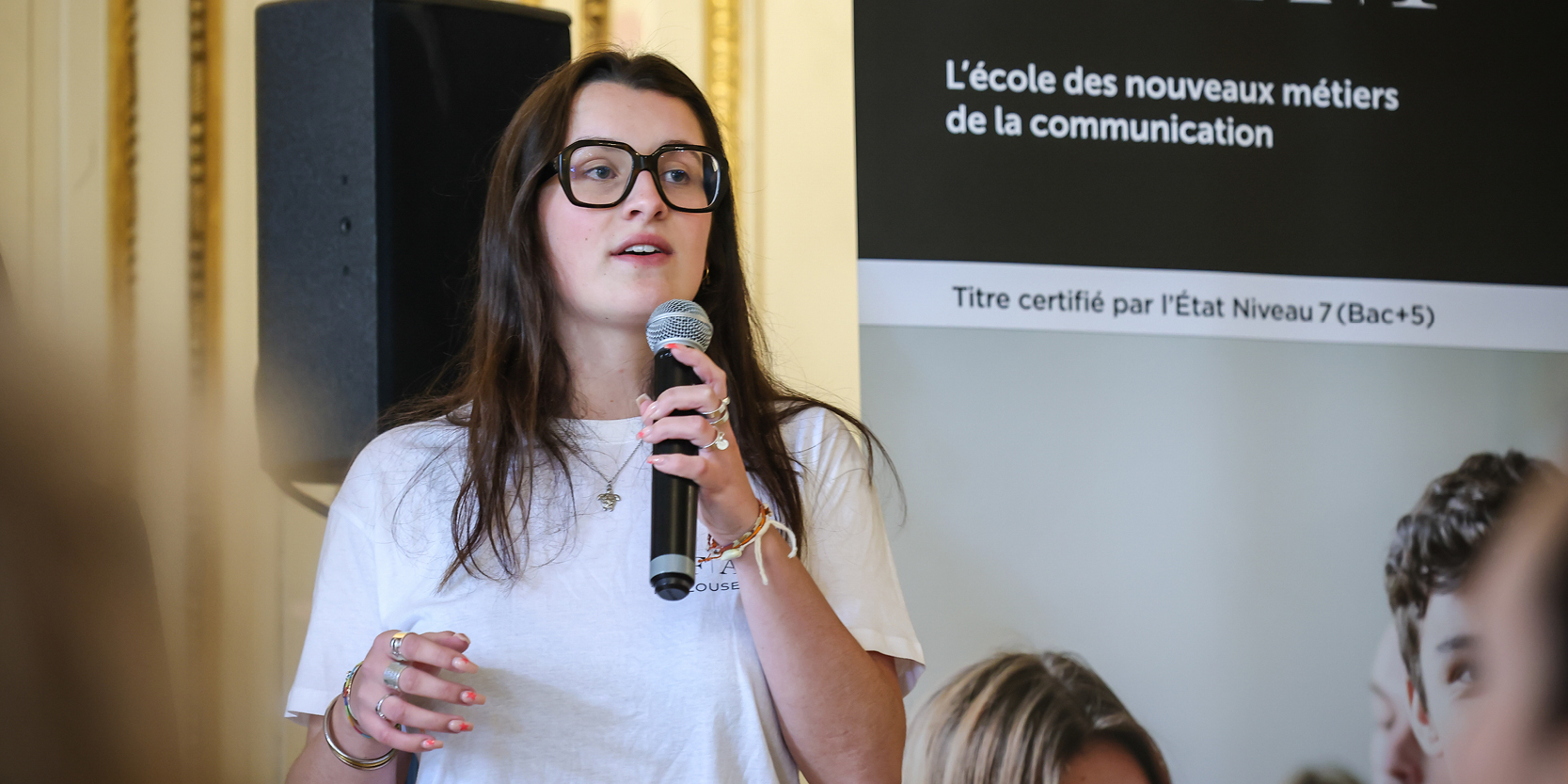
Meet Frédérique Maupu-Flament, lecturer in interpersonal communication and writing techniques at EFAP

My name is Frédérique Maupu-Flament. I am a journalist, fiction writer and specialist in group dynamics and interpersonal communication. I teach public speaking, interpersonal communication and writing techniques at EFAP Paris and EFAP Montpellier. I also host a podcast entitled “What Do You Think, Mum?”, launched with my eldest daughter and aimed in particular at EFAP students.
What do you find most rewarding about teaching students?
What I find most rewarding is the act of transmission itself. I have a guiding principle: “Never do anything that is useless”, taken from the Treatise of the Samurai, which I sometimes ask my students to read. The notion of usefulness is, in my view, essential, especially when addressing younger generations.
What are the main challenges students face when speaking in public?
The main challenge, in my opinion, is the weight of other people’s judgement. It comes up very often. This generation is highly exposed on social media, yet paradoxically finds it difficult to face real-life public speaking situations.
How do you support EFAP students who lack confidence or are afraid of speaking in groups?
I support students throughout the entire learning process, from their very first day in class. Rebuilding confidence is essential. Many of us have lost it, or have not yet developed it. Confidence is a fundamental lever in my teaching, particularly through tools drawn from assertive communication, which is one of my favourite disciplines. The goal is to express oneself clearly, to assert oneself, without ever diminishing others.
What do collective exercises bring to the dynamics of a group of future communicators?
Collective exercises are indispensable, in the philosophical sense of the term. Group dynamics are largely built through these collective activities: role-playing, writing, shared speaking exercises. We write a lot, we produce a lot of spoken and written content to ensure that communication flows within the group. This is essential.
Do you have examples of exercises that have led to strong moments of awareness?
Yes, many. Recently, I asked my students to work on the concept of inner resources — what they can draw upon when facing difficulties. This resulted in texts of great power, both poetic and intellectually precise.
Contrary to popular belief, young people still write, and often with remarkable depth.
What advice would you give young communicators to increase their impact when speaking?
The first piece of advice would be to learn how to listen. Listening is the first step towards speaking. In interpersonal communication, particularly in a professional context, listening — whether as a manager, leader, colleague or interlocutor — is essential.
If you don’t know how to listen, you cannot speak effectively.
If you had to sum up public speaking in three words?
I would say: flair, precision and listening!
Mastering public speaking to gain confidence and influence
In a school of communication like EFAP, public speaking is inseparable from project-based learning. EFAP students regularly present communication strategies, defend creative concepts, pitch recommendations or deliver group projects to their peers, industry professionals or juries. Learning public speaking helps them structure their message, assume their role within a team and convey a clear and convincing vision.
Through public speaking techniques — posture, voice, stress management and argumentation — students gradually build confidence and develop their ability to positively influence an audience. Mastery of oral expression becomes a real differentiating asset, aligned with the expectations of the professional world, where defending an idea, convincing a client or uniting a team around a project is a key skill in communication careers.
An essential skill in the digital and social media era
In the age of social media, video formats and online speaking opportunities, public speaking is no longer limited to the stage or lecture hall. It also takes place on camera, during live streams, conferences or digital content creation. In a school of communication, learning to master oral expression also means training communicators who can embody a brand, convey messages effectively and adapt to all communication contexts, both in-person and digital.
❓ Mini FAQ – Public speaking & schools of communication
Why is public speaking essential in a school of communication?
Because communication careers rely on the ability to defend ideas, persuade audiences and deliver clear messages. Public speaking helps students structure their thinking and assert their professional posture.
How is public speaking linked to project-based learning?
In schools of communication, students regularly present recommendations, strategies or creative concepts. Public speaking is therefore inseparable from teamwork and project success.
Is public speaking useful in the digital and social media era?
More than ever. Videos, on-camera speaking, live streams and online presentations all require mastery of oral expression, voice and argumentation, both online and offline.
Can you learn how to speak well in public?
Absolutely! Through specific techniques (stress management, posture, listening skills and argumentation), public speaking can be learned and refined throughout one’s training.
🗣️ How does EFAP prepare its students for careers in communication?
Learning to structure ideas, convince an audience, develop oral impact and strengthen interpersonal communication enables future communicators to gain confidence and meet professional expectations, both in-person and digital.
Discover EFAP’s communication programmes and prepare yourself for the real demands of communication careers.
See other news

Pourquoi choisir une école d’événementiel pour se former aux métiers de la communication ?
Les métiers de la communication occupent aujourd’hui une place stratégique dans toutes les organisations. Du marketing digital à la communication institutionnelle, en passant par l’événementiel, ces professions exigent créativité, réactivité et sens stratégique. Dans ce contexte, choisir une école d'événementiel spécialisée permet de se former efficacement et de devenir rapidement opérationnel.
read more
Générations EFAP: More Than a School, a Community for Life
Since 1961, generations of EFAP students and alumni have followed in one another’s footsteps, connected and passed on the same shared spirit. With its new brand platform, “Générations EFAP,” EFAP celebrates this enduring bond that makes the school much more than a place to study: a community you join and remain part of for life.
read more

Se former au digital : pourquoi choisir une formation en communication digitale Bordeaux à l’EFAP ?
Le digital et l’intelligence artificielle ont profondément transformé le monde de la communication. Les entreprises recherchent aujourd’hui des profils capables de maîtriser les nouveaux outils numériques, d’analyser les données et de concevoir des stratégies de marque performantes. Dans ce contexte, suivre la formation en communication digitale à Bordeaux proposée par l’EFAP, c’est choisir une voie tournée vers l’avenir. L’école accompagne ses étudiants dans la compréhension des nouveaux usages du web, du marketing d’influence, du contenu de marque et de la data. Les étudiants acquièrent les compétences nécessaires pour répondre aux exigences des métiers du digital, en constante évolution.
read more