 Brochures
  Get in touch
  Join EFAP
 Valentine’s Day 2026: How Brands Are Reinventing Love
Valentine’s Day 2026 has established itself as a strategic opportunity for brands to engage in creative, inclusive and original ways. At this time of year, advertising campaigns are no longer limited to selling a product — they aim to deliver an experience, an emotion, or even a message of inclusion.
Many brands have skillfully combined humor, well-being and engagement, creating messages that resonate with today’s societal concerns while capitalizing on specific products or unique experiences.
Standout Campaigns: When Brands Celebrate Self-Love
Once limited to jewelry, flowers and chocolates, Valentine’s Day campaigns have become far more diverse, moving beyond the traditional image of the romantic couple.
In 2026, several campaigns captured attention by focusing on messages of personal enjoyment, far from the classic codes of the holiday. A striking example is the collaboration between happn and Deliveroo.
The two brands launched an exclusive box together, called “Self-Love Supplement”, to celebrate Valentine’s Day solo. They created this wellness box, including items such as a self-massage kit and happn Premium subscriptions, offered with any Deliveroo order. This initiative perfectly embodies the concept of Self-Love — a way of celebrating oneself beyond the traditional pressures associated with Valentine’s Day.
Special Products: When Valentine’s Day Comes to Our Plates
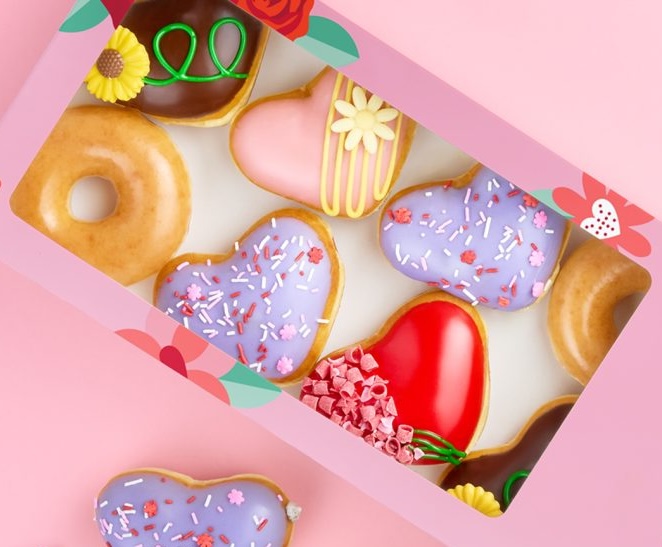
Brands also played with traditional codes by launching dedicated products for Valentine’s Day. Krispy Kreme unveiled its special “Hearts in Bloom” collection, a range of heart-shaped donuts inspired by flowers. Available in a limited edition, this collection allows consumers to celebrate Valentine’s Day in an original way.
Through these products, Krispy Kreme aims to reinvent the Valentine’s Day experience by offering a sweet alternative to the traditional bouquet of flowers. This product fits into a broader trend: the personalization of offers designed to capture consumers’ attention while delivering a differentiated product.
Real and Participatory Experiences: Brands at the Heart of Connections
Brands have also leveraged Valentine’s Day activations by offering real and playful experiences to their audiences. A notable example this year comes from Lime, which launched an innovative initiative to celebrate solo dating. The idea: to label selected venues as “Best Place for a Solo Date”. This label was displayed in various cultural venues, creative workshops and restaurants in Paris, Lille, Nice and Marseille.
Combined with a discount code for free rides on the Lime app, this activation highlighted the solo Valentine’s Day experience and encouraged people to rediscover their city at their own pace, while supporting local businesses.
Another striking initiative came from Asda, a major UK supermarket chain, which introduced “dating baskets” in some of its stores. The concept encouraged customers to carry red baskets to signal their willingness to meet other singles. A clear nod to Valentine’s Day traditions, but with a modern twist and participatory spirit, in an atmosphere that prioritizes human connection. Through this activation, Asda positioned itself as a matchmaking facilitator for those who prefer face-to-face interactions over virtual swipes.
Social Trends: A Fresh Wind in Brand Communication
In 2026, several campaigns stood out for their ability to tap into emerging social trends.
Clash of Clans, for example, highlighted bromance — a strong and camaraderie-filled friendship — staged through a parody of classic romantic films. The brand used humor and absurdity to revisit iconic rom-com scenes, but this time, love is experienced between friends. The campaign shows game characters encouraging unity and camaraderie, challenging traditional representations of Valentine’s Day.
At the same time, many brands adopted a more playful tone, aiming to deconstruct the traditional expectations of the holiday. The goal: to highlight contemporary values such as inclusivity, autonomy and the diversity of relationships. Products and experiences are no longer designed solely for couples, but for all forms of love — friendship, self-love and collective bonds.
Brands have understood that in 2026, Valentine’s Day must celebrate all forms of love, not just a model based on traditional romance. This evolution in communication reflects a desire to connect with a broader audience while remaining relevant in a world where diversity and inclusivity are central values.
Would you like to decode brand strategies and imagine the campaigns of tomorrow?
Valentine’s Day 2026 confirms that the event has become a major creative playground for brands. They leverage emotion, experience and innovation to connect with audiences who no longer settle for traditional romantic clichés. Whether through cultural collaborations, unique experiences or inclusive campaigns, the brands that succeed are those that integrate authenticity, meaning and storytelling into their messaging.
At EFAP, the communication school, students learn to analyze social trends, understand cultural challenges and design high-impact creative strategies.
From brand strategy to digital, event management and responsible communication, our programs prepare you to become the communication professionals capable of creating the campaigns that make a difference.
See other news
Les études de communication à l'EFAP : apprenez à innover dans un secteur en constante évolution
Depuis sa création en 1961, l’EFAP s’impose comme une référence incontournable dans le domaine des études de communication. Classée parmi les 3 premières grandes écoles Bac+5 dans la spécialité Communication & Médias selon le classement Eduniversal 2026, elle se distingue par sa notoriété, la quality de ses formations et la satisfaction de ses étudiants.
read more

Se former au digital : pourquoi choisir une formation en communication digitale Bordeaux à l’EFAP ?
Le digital et l’intelligence artificielle ont profondément transformé le monde de la communication. Les entreprises recherchent aujourd’hui des profils capables de maîtriser les nouveaux outils numériques, d’analyser les données et de concevoir des stratégies de marque performantes. Dans ce contexte, suivre la formation en communication digitale à Bordeaux proposée par l’EFAP, c’est choisir une voie tournée vers l’avenir. L’école accompagne ses étudiants dans la compréhension des nouveaux usages du web, du marketing d’influence, du contenu de marque et de la data. Les étudiants acquièrent les compétences nécessaires pour répondre aux exigences des métiers du digital, en constante évolution.
read more

EFAP: on the podium of the 2026 rankings of the best communication schools
EFAP continues to position itself among the best communication schools in France and internationally. With prestigious rankings that recognize the quality of its programs, the school reaffirms its status as a leader in training future communication professionals. Known for its academic excellence, international outlook, and high employability rate, EFAP prepares its students to face the challenges of an ever-evolving sector, offering them a curriculum tailored to the needs of businesses and contemporary issues.
read more